

The search for natural sources of active compounds is one of the broadest lines of research in basic and applied biotechnology. Traditionally, other microbial platforms have been the main stable sources for the production of bioactive compounds. However, there is a need to explore other microorganisms with advantages in terms of growth, adaptability and unique chemical diversity.
Cyanobacteria and Microalgae : Why Focus on Phototrophic Microorganisms
The microalgae and cyanobacteria are phototrophic organisms that possess the ability to adapt to different environments thanks to a highly efficient metabolism. Derived from them, numerous compounds are produced in primary and secondary metabolism, highlighting lipids (carotenoids, omega-3 and 6 fatty acids, fatty acids that can be converted into biodiesel), proteins (protein pigments, mycosporines), carbohydrates, phenolic acids, antimicrobial compounds, polyketides, etc.
Taken together, they possess numerous bioactive capacities that make them highly attractive in different fields, such as nutraceutical (supplements, functional food), cosmetic, pharma, biofuels, agricultural biostimulants, human and animal nutrition and natural colourants. Within this chemical range, there are bioactive compounds produced only by phototrophic microorganisms, such as phycobiliproteins, omega 3 fatty acids (EPA and DHA), sulphated polysaccharides and the most powerful natural antioxidants that exist: astaxanthin, fucoxanthin and their metabolic precursors.
Sustainability and potential yet to be discovered
On the other hand, their rapid growth, high reproducibility and their ability for acclimatisation to different waste streams as a nutrient medium make microalgae and cyanobacteria the most sustainable and effective natural source of active compounds. Furthermore, only 10% of the taxonomic diversity of this group of microorganisms is known, which increases interest in bioprospecting work in singular or extreme environments.
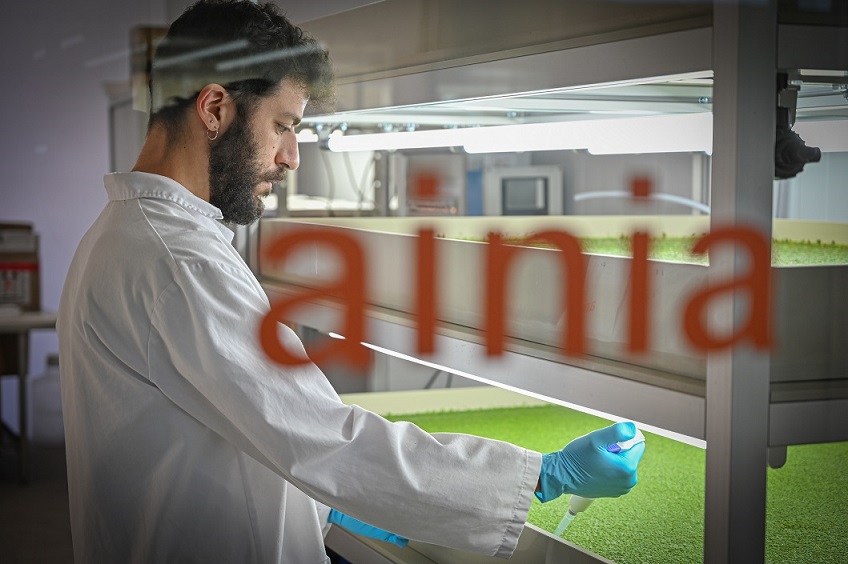
At AINIA we have the facilities and equipment to cultivate numerous species of microalgae and cyanobacteria at different scales, which opens up a range of possibilities to produce “tailor-made” biomasses or extracts rich in compounds of interest. In addition, experience is enabling the cultivation of non-typical species, a highly differentiating characteristic that would make it possible to expand the list of specific compounds from these microbial groups that have not yet been exploited or discovered.
Lines of work: from research to transfer
Specifically, the Aquatic Biomass line works actively on the transformation and transfer of all this knowledge, while reinforcing, complementing and building pioneering and innovative pathways with the support of other lines. This can be translated and classified into different chemical groups of interest:
-
Production of photoprotective compounds: It is considered a backbone axis of the Aquatic Biomass line. Due to the chemical versatility of some groups of substances, they have been studied as potential active extracts both in agricultural crop protection and in the design of cosmetic formulations, with very promising results.
-
Production of protein pigments from cyanobacteria: Natural colourants such as phycocyanin, phycoerythrocyanin and phycoerythrin. All of them are produced exclusively by cyanobacteria of the genera Limnospira, Anabaena and Nostoc. Their natural origin is expected to replace other types of synthetic colourants in the textile or food industry. In addition, their high antioxidant power has expanded their range of applications, enabling their use as active compounds in nutrition, cosmetics and in the treatment of certain chronic diseases.
-
Production of polysaccharides, proteins, amino acids, phenolic compounds: Biotechnological platforms for the production of alternative proteins are the other central axis of the Aquatic Biomass line. The high protein content and their amino acid profile, highly balanced at a nutritional level, position microalgae as a promising source for human and animal nutrition. On the other hand, extracellular and intracellular polysaccharides present thickening, antioxidant and bioactive properties, while phenolic compounds, although generally present in lower concentrations, exhibit high antioxidant capacity and potential bioactivity.
-
Production of apolar pigments through microalgae (eukaryotes): Within this section are the active compounds with the greatest diversity and applications. In turn, it is the most studied group and where the Aquatic Biomass line has the most experience. The most important are certain antioxidant pigments, such as astaxanthin, beta-carotene, lutein and metabolic precursors such as zeaxanthin, canthaxanthin and fucoxanthin. To this end, two-stage cultivation strategies have been developed (biomass production stage and active compound production stage), generating high productivity yields and optimal pigment concentration per cell.
Cyanobacteria and Microalgae: Impact and Next Steps with Industry
In short, from the Aquatic Biomass line we are working to study, discover and implement innovative technologies for the production of active compounds in microalgae and cyanobacteria. Thanks to all the knowledge and experience acquired, internal collaboration pathways and knowledge transfer and external collaboration pathways with companies and other entities are being defined. This translates into better technological positioning of AINIA and progress in various sectors of interest.


