

- Why cereulide matters for food safety
- Bacilus cereus and cereulide toxin: key facts and risks
- Bacilus cereus: higher-risk food categories
- Bacilus cereus: prevention strategies in food manufacturing
- Analytical control (bacteria, toxin and genes)
- AINIA analytical capabilities for cereulide
- References
1. Why cereulide matters for food safety
The recent market withdrawal of several infant foods due to the possible presence of cereulide toxin has highlighted—both to the general public and to the sector—the importance of this food safety hazard. This article provides an overview of the characteristics of this hazard and the risks it entails, as well as the strategies to adopt for its control in the food industry, while also outlining AINIA’s analytical capabilities in this area.
Cereulide toxin, produced by certain emetic strains of Bacillus cereus, has become—within just a few years—an operational priority across many food categories. A recent trigger was the global recall of infant formulas initiated in late 2025 and expanded in January 2026 due to the possible presence of the toxin in an ingredient used across multiple factories and brands of infant nutrition products—an example of how a single ingredient can have worldwide impact in complex supply chains. This toxin is extremely heat-stable and is not inactivated by domestic heat treatments or boiling water, meaning its presence in these foods can pose a potentially serious risk.
2. Bacilus cereus and cereulide toxin: key facts and risks
Bacillus cereus is a group of aerobic, pathogenic, ubiquitous bacteria present in the environment and commonly found in a wide variety of raw materials and foods of agricultural and livestock origin: cereals, spices, aromatic herbs, vegetables, fruit, milk, meat, etc.
- The B. cereus group includes eight formally recognised species, two of which are mainly responsible for foodborne toxicoinfections: B. cereus sensu stricto and B. thuringiensis.
Spore germination capacity makes this bacterium highly resistant, enabling it to grow and multiply in humid, acidic environments and at high salt concentrations, as well as under refrigeration conditions. It is important to note that a low number of spores can trigger toxicoinfection.
Toxin production occurs at temperatures between 24 and 37ºC; however, it cannot occur in the absence of oxygen or below 10ºC. There are two types of toxins produced by B. cereus:
- Emetic toxin or cereulide, produced by certain B. cereus strains.
- Diarrhoeal enterotoxins, produced by both B. cereus and B. thuringiensis. These toxins are generated in the human intestine by the proliferation of spores in direct contact with intestinal epithelial cells.
Cereulide toxin is highly stable across a wide pH range (2–11) and temperature range (stable at 121ºC for 30 minutes). Therefore, it can form in the food before consumption and remain active after reheating or domestic pasteurisation.
Health effects include intense nausea and vomiting, typically appearing within five hours of ingestion and usually resolving within 6 to 24 hours. Gastrointestinal symptoms combined with the toxicity of the toxins themselves make this hazard particularly important for people with weakened immune systems (infants and children under 5, people over 60, cancer patients, diabetics, people living with HIV, patients treated with corticosteroids, etc.), for whom more severe outcomes may occur, such as liver failure (emetic toxin) or necrotising enteritis (enterotoxins).
3. Bacilus cereus: higher-risk food categories
Regarding contamination risk across different foods, this hazard is widely distributed:
- Prepared ready-to-eat foods (meat, fish, vegetables, rice, pasta…).
- Creams, soups, milk and dairy products.
- Infant foods: powdered milk and cereals.
The common element is the combination of persistent spores, biofilm niches, and temperatures that allow multiplication and toxin production in the plant or during distribution.
4. Bacilus cereus: prevention strategies in food manufacturing
Let’s look at the strategies that can be implemented in industry to minimise risk.
Given that emetic intoxication usually involves pre-formed toxin (generated in the product before it is marketed), strategies must prevent contamination, the growth of emetic strains, and toxin synthesis. These strategies should therefore focus on:
- Raw materials and suppliers. Identify sensitive ingredients (for example, fatty/lipid ingredients, cereals, dairy powders, mixes with a historical risk profile) and require microbiological and process specifications targeting B. cereus and, where appropriate, emetic strains. Strengthen supplier audits with a focus on spore control, area segregation, wet/dry cleaning, and evidence of environmental monitoring (including B. cereus and emetic markers).
- Hygienic design and environmental monitoring. Prioritise hygienic equipment design and implement facility zoning to prevent cross-contamination between areas, and include B. cereus in the environmental control programme.
- Time–temperature control. Apply time–temperature criteria—from rapid cooling to chilled or hot holding—to avoid conditions that enable growth.
- Reformulation and barriers. Assess adjustments to pH, water activity, salt, and the presence of preservatives compatible with the product category to limit B. cereus growth.
5. Analytical control (bacteria, toxin and genes)
For the presence of Bacillus cereus and cereulide toxin, different analytical tools are available. The table below summarises their characteristics and the purpose of each approach.
| Bacillus cereus (bacteria) | Cereulide toxin | Related genes | |
|---|---|---|---|
| What it indicates | Presence of the bacterium in the food | Actual presence of the toxin responsible for the emetic syndrome | Strain potential to produce cereulide toxin |
| Associated risk | Contamination and possible toxin production | Intoxication even without viable bacteria | Potential risk; does not confirm toxin is present |
| Analytical methods | Culture-based techniques | LC–MS/MS (quantification) | PCR for genes related to toxin production |
| Interpretation | A high load indicates higher risk but does not ensure the toxin is present. Absence of the microorganism does not guarantee absence of the toxin | Confirmation of the real existence of the risk | Emetic strain, but the toxin may not be present |
| Practical application | Routine microbiological control. Risk assessment | Outbreak investigations and suspect foods | Strain characterisation, risk studies |
In summary, for emetic outbreaks it is recommended to analyse both the presence of B. cereus and cereulide toxin. The bacterium indicates the risk of toxin generation, but only specific toxin analysis can confirm the actual presence of the toxin responsible for the emetic syndrome.
6. Bacilus cereus: AINIA analytical capabilities for cereulide
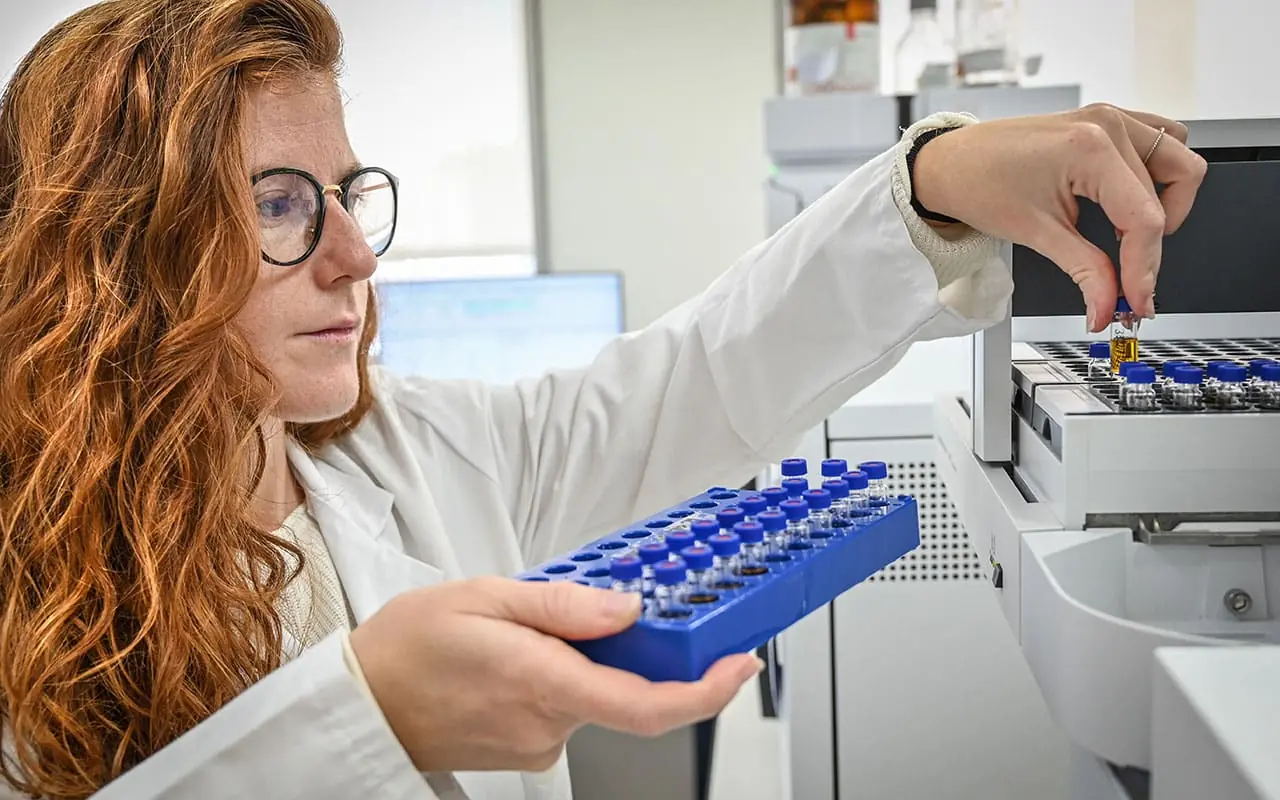
AINIA’s chromatography laboratory has the technique to perform cereulide toxin analysis and is the only national private laboratory offering this service in its portfolio. The analysis is carried out in accordance with EN ISO 18465:2017 (Microbiology of the food chain – Quantitative determination of the emetic toxin). It is applicable to products intended for human consumption, including infant milk. The limit of quantification (LOQ) of our method is 0.2 µg/kg. In addition, we offer an urgent service with results in a maximum of 2 working days.
Our laboratory has participated in the intercomparative exercise for the official validation of the method under the international standard EN ISO 18465, within the framework of European Mandate No. M381 from the European Commission’s Directorate-General for Health and Food Safety (DG SANTE) and the Directorate-General for Internal Market, Industry, Entrepreneurship and SMEs (DG GROW).
7. References
- ELIKA. Fichas de peligros. ELIKA Seguridad Alimentaria | Bacillus – ELIKA Seguridad Alimentaria
- Oxford Academic – Food Quality and Safety (2023). Sources of B. cereus contamination & association with cereulide in dairy and cooked rice processing lines. [academic.oup.com]
- BenchChem Technical Guide (2025). The natural occurrence of cereulide in food products (visión técnica y recopilación de datos). [pdf.benchchem.com]
- ASM mSphere (2024). Global prevalence, genetics and pathogenicity of B. cereus (WGS, clonal complejos, virulencia). [journals.asm.org]
- Food Safety News. Nestlé expands infant formula recall (07 Ene 2026). [foodsafetynews.com]
- ConsumerAffairs. Nestlé expands infant formula recall to more than 50 countries (12 Ene 2026). [consumeraffairs.com]
- Food Standards Agency (UK). Update – SMA Infant & Follow-On Formula recall due to cereulide (2026). [food.gov.uk]


