Subscribe to our newsletter
- R&D&I Programmes
- Technological Services
- Consultancy Services
- Laboratory Services
- Training and Events
- Sectors
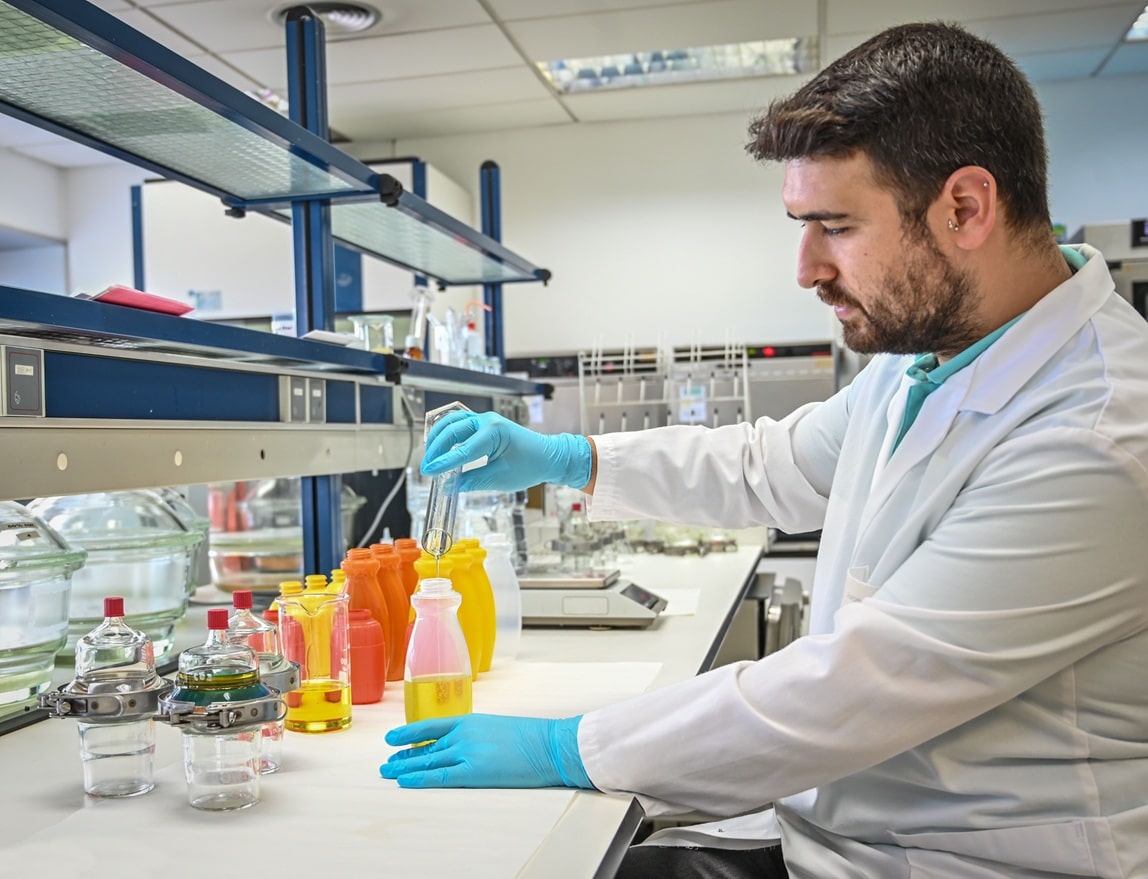

NIAS (Non-Intentionally Added Substances) are chemical compounds of very diverse nature that may be present in plastic food contact packaging and may generate toxicological risks for consumers. To date, there are two main areas of interest in the study and control of NIAS. On the one hand, there is a strong focus on chemical analytical approaches, and on the other, increasing progress in cellular models and biological assessment methodologies aimed at evaluating human exposure to potential health risks.
NIAS can appear in plastic packaging intended to come into contact with food and may pose toxicological risks to human health. One of the main concerns related to NIAS exposure is the potential for toxic and genotoxic adverse effects in humans and in natural biota.
Genotoxic NIAS compounds can induce DNA damage and mutations, and chronic exposure to low doses may affect biodiversity, while in humans it may increase the risk of cancer development.
The origin of NIAS is highly diverse. They may arise from degradation products (from plastics themselves or from additives), impurities in substances used during manufacturing, reaction by-products, or even contaminants introduced during recycling processes.
In practice, NIAS may be generated during a wide range of operations, including polymer processing steps such as injection moulding, extrusion, printing and lamination used to manufacture preformed packaging and household articles, as well as thermoforming and heat sealing during packaging. They may also be associated with food processing operations such as hot filling, pasteurisation and sterilisation, and with food preparation by consumers using microwaves or conventional ovens.
Particularly concerning are packaging materials manufactured from recycled plastics, as their production involves decontamination processes that apply severe conditions (temperature, pressure, etc.), as well as substances used to restore mechanical properties. Both the operations and the processes involved may act as sources of NIAS generation or may be insufficient to eliminate unknown substances.
Due to the unknown nature of many NIAS and their potential adverse effects on human health, food contact materials legislation has placed strong emphasis on NIAS risk assessment, together with the application of Good Manufacturing Practices (GMP) to minimise their presence.
However, because of the limited knowledge regarding the chemical identity and concentration levels of NIAS, there is no specific legislation regulating each substance individually. Instead, the legal framework promotes risk-based evaluation, following internationally recognised scientific principles for risk assessment.
According to Regulation (EC) No 1935/2004 on materials and articles intended to come into contact with food (the Framework Regulation), any material or article intended to come into direct or indirect contact with food must be manufactured in accordance with GMP so that, under normal or foreseeable conditions of use, it does not transfer substances to food in quantities that could endanger human health.
Similarly, Regulation (EU) No 10/2011 on plastic materials and articles intended to come into contact with food acknowledges that NIAS may be present in plastic materials even if they are not included in the Union List, provided that they are subject to risk assessment to verify compliance with general safety requirements. Therefore, NIAS control is a regulatory requirement under both the Framework Regulation and the specific measures applicable to plastics.
Furthermore, the new Declaration of Compliance requirements introduced by Regulation (EU) 2025/351 mandate the inclusion of information on NIAS for materials placed on the market from 16 September 2026 onwards. To ensure safety, economic operators must receive all relevant information regarding the safety of the plastic materials and articles they manufacture or use.
To assess the risk associated with NIAS exposure, the first step is the toxicological hazard classification of each identified substance. It is verified whether the substance is regulated and complies with applicable legal limits (e.g. SML values under Regulation (EU) No 10/2011) when reference values exist.
For substances with no specific toxicological data, the Threshold of Toxicological Concern (TTC) approach is applied, based on Cramer classification, which assigns intake thresholds considered to be of “no appreciable concern” according to chemical structure.
In parallel, exposure assessment is carried out for each NIAS, taking into account the intended use of the material. Based on concentrations measured in food simulants, Estimated Daily Intakes (EDI) are calculated using food consumption assumptions (kg of food/day and surface-to-volume ratios). Available toxicological studies (NOAEL, genotoxicity data) are reviewed, and where concerns exist, additional tools such as QSAR models or Ames tests are considered, with priority given to excluding mutagenicity. Risk characterisation is then performed by comparing exposure estimates with TTC or NOAEL values, applying appropriate uncertainty factors.
“To date, there are two main approaches to NIAS control and elimination: analytical characterisation on the one hand, and the development of rigorous methodologies to assess toxicological exposure to largely unknown substances on the other.”
The identification of unknown substances is highly complex, mainly due to three factors:
Lack of detailed information on the real composition of raw materials and components used to produce polymers and final packaging.
Use of additives, adhesives, coatings and inks whose chemical structures are often modified to achieve specific functionalities required by manufacturers. These functionalities and production processes are not always disclosed, and the absence of harmonised EU regulation further complicates identification.
Very low concentrations of NIAS, which require the development of highly sensitive analytical techniques, such as high-resolution mass spectrometry (HR-MS), to improve detection limits.
Given the wide chemical diversity of NIAS, applying a single analytical technique may lead to biased or incomplete results. For this reason, robust nias analysis requires the combination of different sample preparation strategies and analytical approaches, as no single comprehensive method currently exists.
This makes NIAS analysis a highly relevant field for R&D, aimed at establishing rigorous methodological frameworks for chemical risk assessment in complex matrices such as food contact materials.
The use of recycled materials is already a reality, supported by recycling processes that have been positively evaluated by EFSA, allowing recycled plastics to be used as raw materials for new packaging.
However, there is still limited knowledge regarding residual substances from recycling processes or substances generated during high-temperature treatments applied during recycling. Moreover, the potential consumer exposure risk associated with these substances remains insufficiently characterised.
At the same time, the growing trend towards convenience packaging and more sustainable solutions has led to an increasing number of packaging materials being exposed to high temperatures, either during industrial processing or during consumer use. The incorporation of recycled materials into convenience packaging further contributes to the formation of complex material matrices, in which unknown substances may be present.
As a result, systematic nias analysis and risk assessment are essential to ensure consumer safety in this evolving packaging landscape.


| Responsible | AINIA |
| Address | Calle Benjamín Franklin, 5 a 11, CP 46980 Paterna (Valencia) |
| Purpose | To attend to, register and contact you to resolve the request you make to us through this contact form |
| Legitimation | Your data will be processed only with your consent, by checking the box shown on this form |
| Recipients | Your data will not be transferred to third parties. |
| Rights | You have the right to request access to, correct or delete your data. You can also request that we limit its processing, oppose it and request the portability of your data by contacting our postal address or [email protected] |
| More info | You can find more information in our Privacy Policy |
| DPO | If you have any questions about how we will treat your data or would like to make any suggestions or complaints, please contact the Data Protection Officer at [email protected] or at the Data subject support form |
I consent to the use of my personal data to process my request, as set forth in your Privacy Policy
I consent to the use of my data to receive information and commercial communications from your entity.

Head office
Parque Tecnológico de Valencia
Av. Benjamín Franklin, 5-11
46980 Paterna, Valencia
+34 961 366 090
+34 963 052 525 · Laboratories

