Hybrid future: when the competitive advantage is no longer in automating, but in integrating better
David Martínez Simarro / 17 March 2026
Hybrid future: when the competitive advantage is no longer in automating, but in integrating better
Artificial intelligence is no longer a promise. Collaborative robotics is no longer a rarity on the factory floor. And above all, the real differentiator is no longer just adopting technology, but deciding from which position we integrate it: leading the transformation or reacting to it.
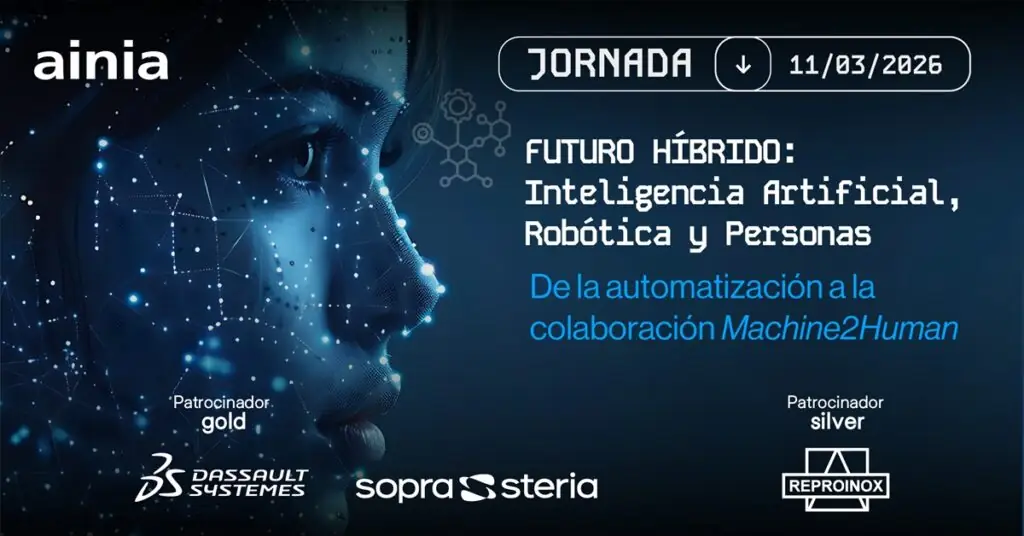
That was the starting idea of the webinar Hybrid future: artificial intelligence, robotics and people, where we focused on a key issue for industry: the next wave of competitiveness will be defined by the ability to design hybrid systems in which artificial intelligence, automation and human talent work in a coordinated way, with real impact on the business and without noise.
From option to necessity: transformation can no longer be postponed
One of the clearest messages from the meeting was that digital transformation is no longer an optional initiative. The combination of more mature artificial intelligence, more flexible robotics and increasing competitive pressure is widening the gap between companies that learn and execute quickly, and companies that remain in isolated experiments without direction.
Today many organisations are doing “something” with artificial intelligence. The difference is whether that “something” responds to a roadmap connected to the company’s competitive strategy, or whether it is a set of scattered initiatives that neither scale nor generate internal traction.
What a hybrid system is (and is not) in 2026
During the discussion an essential point was clarified: a hybrid system is not half human and half machine. It is a system in which each part does what it does best and integrates with intention.
On the one hand, artificial intelligence and automation increase capability: they turn data into useful information, reduce operational workload and help make decisions faster and with higher quality.
On the other hand, human talent remains the element that leads: it defines objectives, interprets context, manages risks, prioritises and makes decisions.
As explained by the Head of Artificial Intelligence Architecture at Sopra Steria, Eduardo Sánchez, industrial reality requires human supervision, control and the ability to bring solutions into real operations. Value arrives when it is well integrated into processes, not when it remains in demonstrations.
Along the same lines, the Sales Director for Spain and Portugal at Dassault Systemes, Fernando García, stressed that integration is not limited to production: it also impacts planning, new product launches, formulation, quality, regulatory compliance and the relationship with the market. The hybrid approach is transversal.
Why 2026 is not “just another year”
During the webinar several reasons were shared as to why we are facing a structural change:
Technological acceleration with practical application
The progress of artificial intelligence has been very fast, but what is different now is its deployment in concrete cases with return, connected to real processes.
Technology more accessible to industry
Available infrastructure, more mature tools and widespread adoption have reduced barriers. Technology is within reach… and that raises the competitive bar.
Competition and consumers as drivers of change
The market pressures companies to innovate faster, personalise and reduce friction. And consumers, increasingly informed, push towards new standards.
Regulatory complexity as a strategic variable
In an environment with different requirements by countries and markets, having digital support to anticipate impacts and reduce risks becomes a lever of competitiveness.
The talent factor: the ultimate multiplier
One particularly relevant idea was the relationship between hybrid systems and talent. Artificial intelligence does not only automate: it also amplifies capabilities.
Teams with a high level can multiply their impact.
Profiles anchored in rigid ways of working can become a real brake for the organisation.
This connects with a growing challenge: attracting and retaining profiles capable of driving transformation. If an organisation does not evolve, it stops being attractive for professionals who seek to contribute in advanced environments. As a result, the competitive gap also opens through the most critical path: people.
Changes in roles: when contribution is redefined
During the discussion a phenomenon already visible in many organisations was highlighted: part of the intermediate roles traditionally focused on collecting and transferring information face a profound change. If systems automatically generate reports and monitoring dashboards, the value shifts towards:
understanding the business with technical criteria,
asking the right questions,
translating data into decisions,
leading adoption and change.
It is not about replacing people, but redefining where they add the most value.
Five signals to know whether you are leading… or being overtaken
If tomorrow an executive wanted a quick self-assessment, these signals are a good starting point:
There are progress indicators connected to strategy
It is not enough to “implement artificial intelligence”. Impact must be measured: time, waste, quality, productivity, speed of launch, risk, etc.
The organisation can analyse competitors and trends with agility
If preparing a competitive analysis takes months, there is a clear problem of speed and tools.
Processes and knowledge are defined and organised
Without clear processes and structured knowledge, artificial intelligence does not scale. It only generates isolated tests and subsequent frustration.
Start with cases with visible value and rapid adoption
Prioritising initiatives with impact and low cost of change accelerates internal confidence and reduces friction.
There is a realistic adoption and change management plan
Without this, projects drag on, lose credibility and stall.
David Martínez Simarro
Professional specialized in digital transformation and technological innovation, with extensive experience in developing solutions based on digital technologies, data, and AI, as well as applying advanced technologies to the industrial and agri-food sectors.
I drive digital, technological, and business strategy, leading the development of capabilities in artificial intelligence, advanced data analytics, and digital platforms, as well as creating strategic partnerships with companies, research centers, and public administrations.
My work focuses on turning technology into real value for companies, promoting innovation, collaboration, and sustainable growth through digitalization and data.
Calle Benjamín Franklin, 5 a 11, CP 46980 Paterna (Valencia)
Purpose
To attend to, register and contact you to resolve the request you make to us through this contact form
Legitimation
Your data will be processed only with your consent, by checking the box shown on this form
Recipients
Your data will not be transferred to third parties.
Rights
You have the right to request access to, correct or delete your data. You can also request that we limit its processing, oppose it and request the portability of your data by contacting our postal address or [email protected]
If you have any questions about how we will treat your data or would like to make any suggestions or complaints, please contact the Data Protection Officer at [email protected] or at the Data subject support form
I consent to the use of my personal data to process my request, as set forth in your Privacy Policy
I consent to the use of my data to receive information and commercial communications from your entity.
David Martínez Simarro
Jefe de Desarrollo Estratégico de Negocio y Alianzas
Suscríbete a nuestra newsletter
Mantente al día de lo más destacado sobre innovación y nuevas tecnologías.
Gestionar el consentimiento de las cookies
We use our own and third-party cookies that provide us with statistical data and user browsing habits. This helps us improve our content and services, and even show advertising related to user preferences. You can activate these cookies by clicking the “Accept cookies” button. If you prefer to keep these cookies disabled, click the “Reject cookies” button. You can even activate and deactivate the ones you prefer by clicking the “Customize cookies” button. More information in our Cookies Policy
Técnicas
Always active
El almacenamiento o acceso técnico es estrictamente necesario para el propósito legítimo de permitir el uso de un servicio específico explícitamente solicitado por el abonado o usuario, o con el único propósito de llevar a cabo la transmisión de una comunicación a través de una red de comunicaciones electrónicas.
Preferencias
El almacenamiento o acceso técnico es necesario para la finalidad legítima de almacenar preferencias no solicitadas por el abonado o usuario.
Estadísticas
El almacenamiento o acceso técnico que es utilizado exclusivamente con fines estadísticos.El almacenamiento o acceso técnico que se utiliza exclusivamente con fines estadísticos anónimos. Sin un requerimiento, el cumplimiento voluntario por parte de tu proveedor de servicios de Internet, o los registros adicionales de un tercero, la información almacenada o recuperada sólo para este propósito no se puede utilizar para identificarte.
Marketing
El almacenamiento o acceso técnico es necesario para crear perfiles de usuario para enviar publicidad, o para rastrear al usuario en una web o en varias web con fines de marketing similares.