

Roberto Ortuño / 24 March 2026

E. coli Bacteria in Food: Risks and Control Strategies in the Food Industry

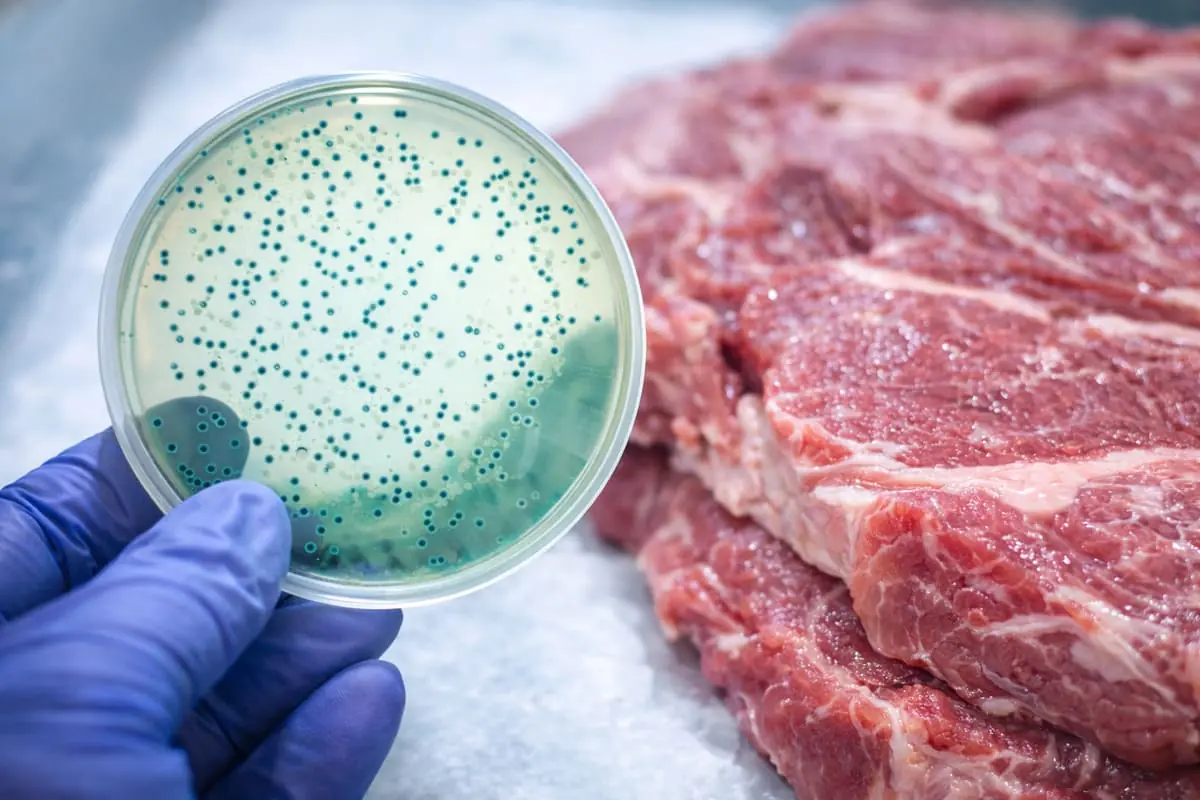
The presence of Escherichia coli in food continues to be one of the main challenges in food safety worldwide. Although many strains are part of the normal intestinal microbiota of humans and animals, certain pathogenic variants are responsible for serious outbreaks associated with meat, dairy and fresh produce products.The increase in outbreaks in recent decades has highlighted the need to apply integrated control strategies, from primary production to the final consumer, under a risk-based and preventive management approach. In this article, we will look at:

What is E. coli and why is it relevant in food safety?

Escherichia coli is a bacterium commonly present in the digestive tract of animals and humans. Due to its intestinal abundance, it is used as an indicator of faecal contamination in water and food. Most strains are commensal and harmless. However, some pathogenic varieties possess genetic information that allows them to:
  • Produce toxins (such as shiga toxins)
  • Adhere to and invade intestinal cells
  • Alter cellular metabolism
  • Cause tissue destruction
Among the most relevant strains are STEC (Shiga toxin-producing E. coli) and their EHEC (Enterohemorrhagic E. coli) subgroup, especially serotype O157:H7, associated with haemorrhagic diarrhoea and, in severe cases, haemolytic uraemic syndrome (HUS). A critical aspect from a microbiological point of view is its capacity for genetic exchange through plasmids and bacteriophages, which favours the emergence of new variants that are more virulent or resistant to antimicrobials. Its relevance in food safety lies in three key factors:
  1. Low infectious dose in certain strains.
  2. High survival capacity in different food matrices.
  3. Possibility of transmission throughout the food chain.

Main routes of E. coli contamination in food

E. coli contamination is predominantly of faecal origin, both human and animal. The main routes are:

Contamination in primary production

  • Use of untreated manure.
  • Contaminated irrigation water.
  • Soils fertilised with insufficiently composted organic matter.
  • Presence of wild animals or livestock in cultivation areas.

Contamination during slaughter and milking

Ruminants, especially cattle, are considered the main reservoir of STEC and EHEC. In products of animal origin, contamination usually occurs through:
  • Intestinal spillage during slaughter.
  • Inadequate hide removal.
  • Hygiene deficiencies in slaughterhouses.
  • Incorrect handling in milking facilities.

Cross-contamination during processing and distribution

  • Contaminated surfaces.
  • Infected handlers or asymptomatic carriers.
  • Uncontrolled process water.
  • Poorly sanitised equipment.

Subsequent growth in food

Bacterial growth can occur when parameters such as the following are not controlled:
  • Storage temperature.
  • pH.
  • Water activity.
  • Exposure time.
Some strains can tolerate adverse conditions, such as acidic environments in juices or fermented products, which increases the complexity of control.

Foods at greater risk of contamination

A wide variety of foods can act as a vehicle for E. coli, depending on their ecology and production conditions.

Products of animal origin

  • Raw or insufficiently cooked minced meat.
  • Fermented meat.
  • Raw milk and unpasteurised cheeses.
Contamination usually originates during slaughter or milking, with fresh meat and raw milk being the most common vehicles.

Fresh produce

  • Lettuce.
  • Spinach.
  • Melons.
  • Mushrooms.
  • Sprouted seeds.
Sprouted seeds represent a significant risk, since during the germination process small initial contaminations can multiply rapidly until they reach infectious levels

Juices and processed foods

  • Unpasteurised juices.
  • Minimally processed products.
  • Ready-to-eat foods (RTE).
In processed foods, the survival of a few viable cells may be enough to cause disease if appropriate heat treatments or multiple barriers are not applied.

Control of E. coli in the food industry

The effective control of E. coli requires a comprehensive approach, based on multiple barriers and preventive risk management.
  • Primary production
  • Slaughterhouses and processing
  • Fresh products and sprouted seeds
  • Distribution, retail and consumer
E. coli prevention cannot be addressed from a single control point. As the FAO indicates in its Crisis Management Framework for the Food Chain, it is necessary to:
  • Identify critical points throughout the whole chain.
  • Apply differentiated interventions according to the epidemiological variant.
  • Adopt an interdisciplinary approach integrating animal health, plant production and public health.
The key is no longer only to react to outbreaks, but to anticipate risk and design robust preventive systems capable of minimising the probability of contamination and protecting both the consumer and business reputation. Patógenos

Roberto Ortuño

Head of Food Safety and Quality at AINIA Technology Centre.Agricultural Engineer.Vice-President of the Spanish Society for Food Safety and Quality.

Related news

icono izquierdaicono derecha

Do you find this topic interesting?
Contact us

Basic information on data protection

Responsible AINIA
Address Calle Benjamín Franklin, 5 a 11, CP 46980 Paterna (Valencia)
Purpose To attend to, register and contact you to resolve the request you make to us through this contact form
Legitimation Your data will be processed only with your consent, by checking the box shown on this form
Recipients Your data will not be transferred to third parties.
Rights You have the right to request access to, correct or delete your data. You can also request that we limit its processing, oppose it and request the portability of your data by contacting our postal address or [email protected]
More info You can find more information in our Privacy Policy
DPO If you have any questions about how we will treat your data or would like to make any suggestions or complaints, please contact the Data Protection Officer at [email protected] or at the Data subject support form

I consent to the use of my personal data to process my request, as set forth in your Privacy Policy

I consent to the use of my data to receive information and commercial communications from your entity.

Roberto Ortuño
Responsable de Seguridad y Calidad Alimentaria en AINIA

Suscríbete a nuestra newsletter

Mantente al día de lo más destacado sobre innovación y nuevas tecnologías.
SUSCRIBIRME
close-link