
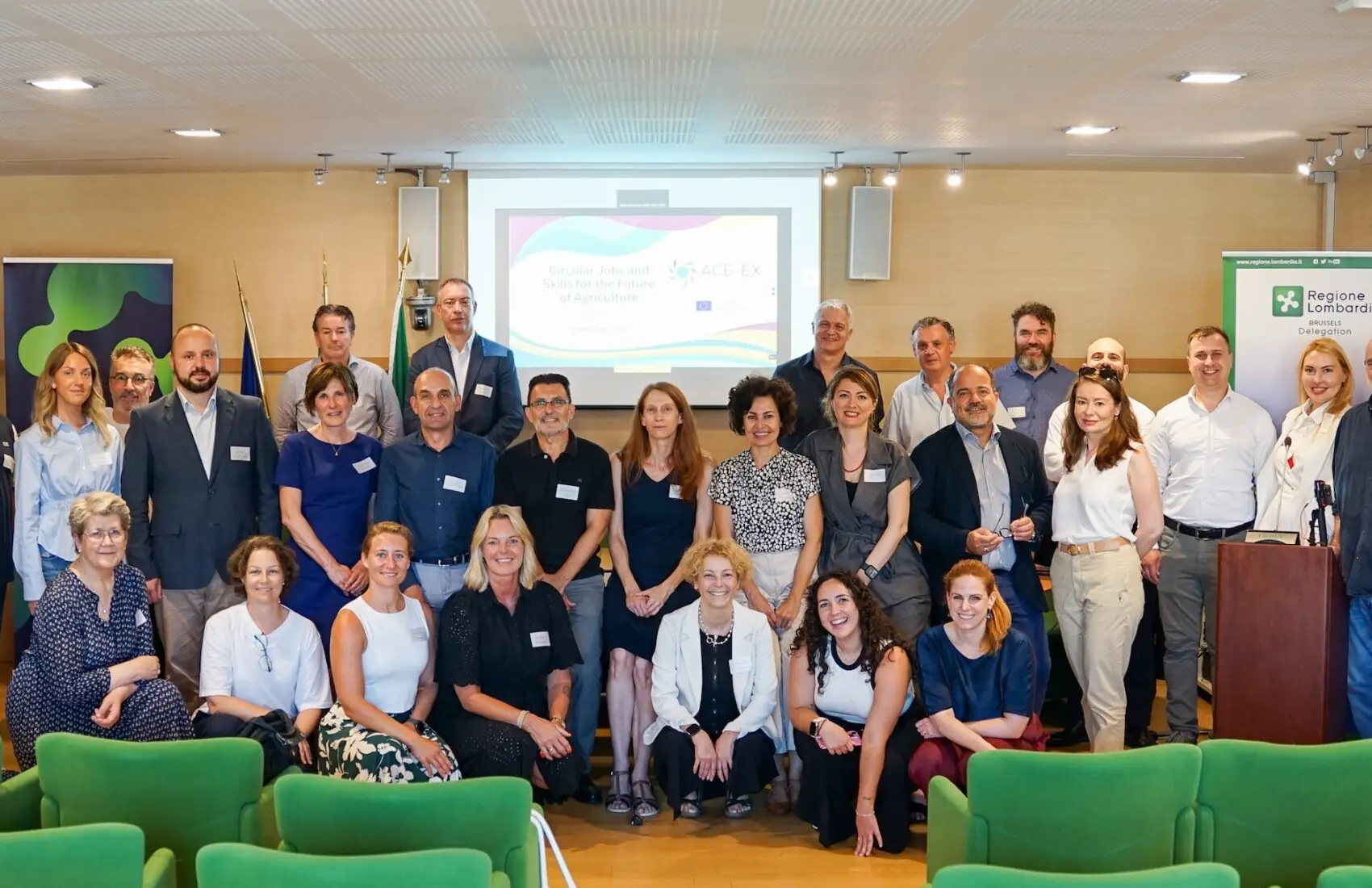

If the sector changes its model, are the people who work in it ready to change with it? It is around that question that twenty partners from nine countries have, over these years, built a training pathway for the circular economy in agriculture. And it is around that question that the voices of policy, industry, labour and the regions spent a full day in conversation.
There is a misconception ACE-EX set out to challenge from the start: the belief that the green transition in farming is mostly a matter of machines, plants and technology. Presenting the project’s results, Carmen Fusilli (ITS Academy Giulio Natta), who coordinated the consortium, turned that assumption on its head. Circularity, she explained, is not achieved by installing a biodigester, but by training the people who will have to make it work day after day. It is a subtle and decisive distinction, and it explains why a project about the circular economy is, in truth, a project about skills.
Those skills the project mapped by starting from a needs analysis of the sector, which exposed an uncomfortable point: technical knowledge, on its own, is no longer enough. Hence, a pathway was built on four pillars that hold together worlds too often kept apart: leadership and soft skills; green technologies and the circular economy; sustainability; and innovation and entrepreneurship. On that structure grew a full training ecosystem of multilingual e-learning modules, a handbook, a serious game and virtual reality experiences, piloted with more than 1,400 students, teachers and professionals. Not a catalogue of courses, but an attempt to give shape to a professional figure the market is already looking for without quite knowing how to name it.
That such a figure really exists was confirmed by the day’s first roundtable, chaired by Erina Guraziu (OpenCom), where policy, industry, unions and regions described the same transformation from four vantage points. For Ricard Ramon i Sumoy (European Commission, DG AGRI), tomorrow’s farmer looks less and less like a mere producer of food and more like a knowledge-intensive entrepreneur, managing data, renewable energy and precision agriculture, and needing digital literacy and adaptability to do so. From the industry side, Ricard Celorio (FoodDrinkEurope) shifted the emphasis onto a problem Europe knows well: it is not research that is lacking, but the ability to scale it. What is needed are professionals who can collaborate across value chains and turn the principles of the circular economy into real production processes.
If policy and industry look at the system, Ivan Ivanov (EFFAT) brought the conversation back to people. A transition, he reminded the room, is not automatically fair: it can create new technologies and still leave workers behind. For it to be just, it needs continuous training, genuine opportunities to reskill, and a social dialogue that accompanies change rather than enduring it.
Closing the circle, joining remotely, Lucia Silvestri (Lombardy Region) noted that no innovation has any effect if it stays on paper: it is the regions that bridge education systems and the labour market, and that carry opportunity to where it risks never arriving, to young farmers, to women entrepreneurs, to marginal areas.
The second roundtable, chaired by Jesús Díez Vázquez (Fundación del Patrimonio Natural de Castilla y León), moved the question from the “who” to the “on what terms”: is the circular transition economically sustainable too? Here positions diverged, and it was the most compelling moment of the day. Paolo Di Stefano (Eat Europe) defended the idea of agriculture being recognised as a strategic sector, criticising approaches that reward the environment by cutting production and asserting farmers’ right to produce more food, as well as biomass and renewable energy. Théo Paquet (European Environmental Bureau) held the opposite and complementary line: circularity should rest on waste streams, not compete with food production, and calls for a more territorial approach to livestock. Between them, the economic analysis of Trevor Donnellan (Teagasc), who recalled how the volatility of energy and fertiliser prices has destabilised farm incomes, and the view that reducing energy dependence is now a question of competitiveness before it is one of the environment.
It is telling that a project about training should end with such a lively debate about economics. Because it is precisely there that skills reveal their worth: without professionals able to read data, manage energy and rethink processes, none of those strategies becomes real. Folco Ciulli (European Chemical Regions Network) said as much in his closing remarks: on a continent poor in raw materials and with high labour costs, skills are Europe’s true competitive advantage. And competitiveness and circularity, he added, are not adversaries: European funding should accelerate a change one has to believe in first.
It was fitting that the day ended with the virtual reality demonstration led by Oliver D’Adda (Softcare Studios), with participants immersed in a learning environment rather than seated before a slide. In that image lies the wager of ACE-EX: that how people are trained matters as much as what they are taught. The project ends here, but its materials remain, and the partners have committed to sharing them beyond the deadline, because a transition that turns on skills cannot end when the funding does. The question that opened that day in Brussels, after all, will concern European agriculture for many years to come.
More at: www.ace-ex.eu


| ACE-EX (Agriculture Circular Economy Expert, no. 101110547) is an Erasmus+ KA2 Alliance for Innovation project, co-funded by the European Union. Views and opinions expressed are those of the authors only and do not necessarily reflect those of the European Union or EACEA, which cannot be held responsible for them. |



