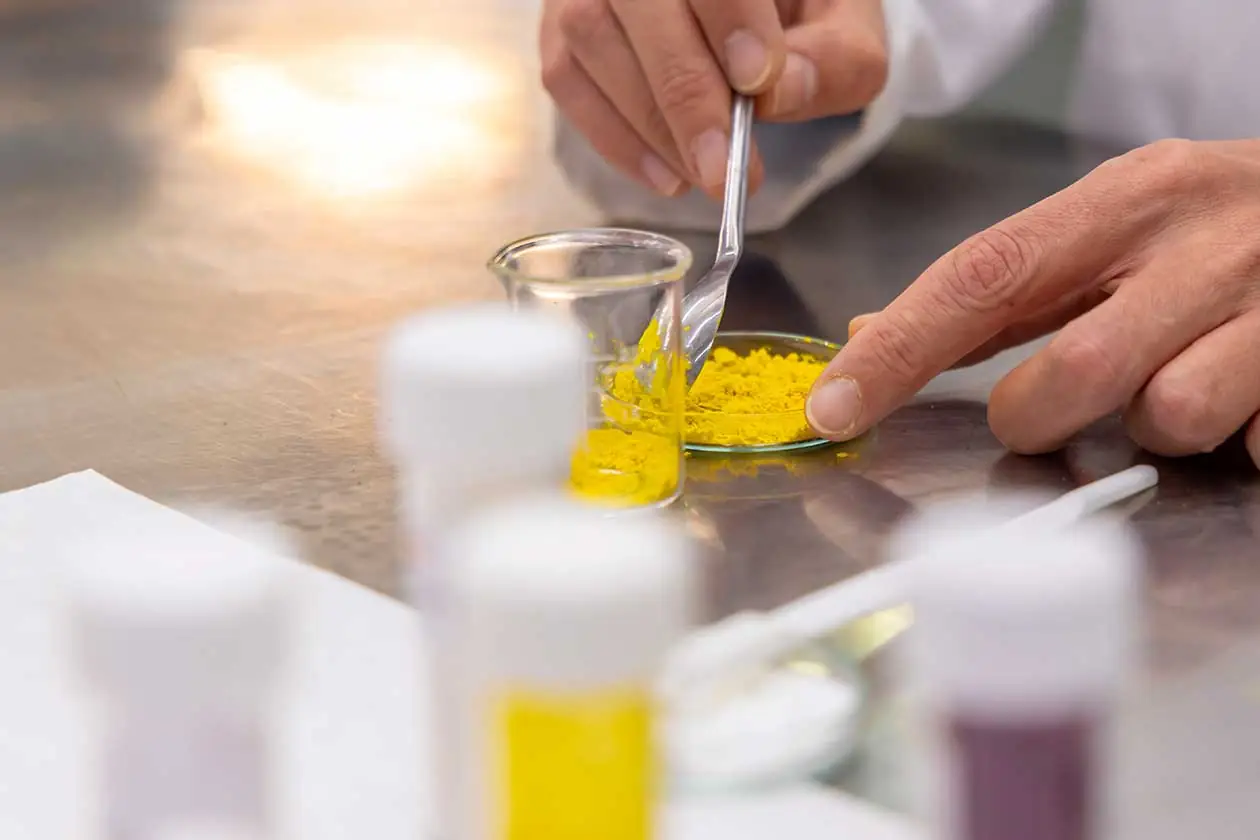
Preserving the sensory properties of cosmetic extracts — including aroma, colour and freshness — requires a direct intervention on the physical and chemical mechanisms that drive degradation.
For highly sensitive ingredients, structural protection strategies such as encapsulation play a key role in isolating volatile compounds and maintaining their integrity throughout the product life cycle.Below are the main technical strategies commonly applied in the cosmetic sector to reinforce the stability of sensory properties in natural extracts.
1. Minimising oxygen exposure
What does it address?
Oxidative degradation of aromatic compounds and natural colourants.
How is it implemented?
Closed processing systems or inert atmospheres.
Vacuum-controlled equipment with nitrogen purging.
Barrier packaging materials with low oxygen permeability.
Sensory benefit
Preserves freshness and prevents the development of rancid or off-odours.
2. Thermal control in critical process stages
What does it address?
Thermal degradation of volatile and thermolabile compounds.
How is it implemented?
Low-temperature extraction and concentration technologies.
Controlled heating during blending and processing.
Stable temperature profiles during storage and logistics.
Sensory benefit
Protects volatile fractions and prevents simplification of the aromatic profile.
3. Protection against light during processing and storage
What does it address?
Photodegradation caused by UV and high-energy visible radiation.
How is it implemented?
Controlled lighting conditions in production areas.
UV filtering systems or red-light environments.
Opaque packaging or materials with UV-blocking additives.
Sensory benefit
Maintains colour stability and prevents photo-induced off-notes.
4. Formulation optimisation: pH, matrix and ingredient compatibility
What does it address?
Unwanted interactions between the extract and the cosmetic matrix.
How is it implemented?
pH adjustment within stability-compatible ranges.
Evaluation of surfactants, polymers and lipid phases that may bind aroma compounds.
Removal of catalytic metal traces through filtration or chelating agents.
Sensory benefit
Prevents loss of intensity and limits secondary degradation reactions.
5. Structural protection systems: encapsulation and controlled release
What does it address?
High sensitivity of extracts to oxygen, light and temperature.
How is it implemented?
Double encapsulation systems for highly volatile extracts.
Polymeric matrices with controlled release behaviour.
Sensory benefit
Enhanced stability, protection against oxidation and optimised release in the final formulation.
6. Comparison of encapsulation techniques
Technique
Best suited for
Key advantages
Spray chilling
Oils and lipophilic fragrances
High stability; moisture barrier; temperature-triggered release
Spray drying with organic solvents
Thermosensitive actives
Low thermal stress; particle size control
Ionic gelation
Water-soluble actives and plant extracts
Mild conditions; good oxidative protection; controlled release
Supercritical CO₂ encapsulation
Delicate fragrances and terpenes
No organic solvents; minimal oxidation; excellent aroma preservation
Microcapsule agglomeration
Fine powders and difficult-to-handle ingredients
Improved handling; better redispersion; adjustable final particle size
Fundedbytheaidprogramforhiringyoungprofessionalsspecialized in internationalization
Daniel Rivera
Chemical engineer from the University of the Basque Country and Master’s in Food Science and Engineering from the Polytechnic University of Valencia, my entire professional career has been linked to the chemical industry across different sectors, from mining and metallurgy to food and cosmetics. Since joining AINIA in 2007, I have worked in applied research in the development and implementation of industrial processes, initially focused on micro- and nanoencapsulation technologies, and more recently on purification, active compound concentration, and water treatment and reuse. My motivation has always been to see new real products on the market thanks to R&D&i.
Calle Benjamín Franklin, 5 a 11, CP 46980 Paterna (Valencia)
Purpose
To attend to, register and contact you to resolve the request you make to us through this contact form
Legitimation
Your data will be processed only with your consent, by checking the box shown on this form
Recipients
Your data will not be transferred to third parties.
Rights
You have the right to request access to, correct or delete your data. You can also request that we limit its processing, oppose it and request the portability of your data by contacting our postal address or [email protected]
If you have any questions about how we will treat your data or would like to make any suggestions or complaints, please contact the Data Protection Officer at [email protected] or at the Data subject support form
I consent to the use of my personal data to process my request, as set forth in your Privacy Policy
I consent to the use of my data to receive information and commercial communications from your entity.
Daniel Rivera
Ingeniero químico por la universidad del País Vasco y Master en Ciencia e Ingeniería de los alimentos por la Universidad Politécnica de Valencia, toda mi actividad profesional ha estado ligada a la industria química en diferentes sectores. Desde minería y metalurgia, hasta alimentación y cosmética. Desde que formo parte de AINIA, en 2007 he trabajado en investigación aplicada en el desarrollo e implementación de procesos industriales. Inicialmente centrados en tecnologías de micro y nanoencapsulación, y mas recientemente en purificación, concentración de activos y tratamiento y reutilización de aguas. Mi motivación siempre ha sido poder ver nuevos productos reales en el mercado gracias a la ImasD.
Suscríbete a nuestra newsletter
Mantente al día de lo más destacado sobre innovación y nuevas tecnologías.
Gestionar el consentimiento de las cookies
We use our own and third-party cookies that provide us with statistical data and user browsing habits. This helps us improve our content and services, and even show advertising related to user preferences. You can activate these cookies by clicking the “Accept cookies” button. If you prefer to keep these cookies disabled, click the “Reject cookies” button. You can even activate and deactivate the ones you prefer by clicking the “Customize cookies” button. More information in our Cookies Policy
Técnicas
Always active
El almacenamiento o acceso técnico es estrictamente necesario para el propósito legítimo de permitir el uso de un servicio específico explícitamente solicitado por el abonado o usuario, o con el único propósito de llevar a cabo la transmisión de una comunicación a través de una red de comunicaciones electrónicas.
Preferencias
El almacenamiento o acceso técnico es necesario para la finalidad legítima de almacenar preferencias no solicitadas por el abonado o usuario.
Estadísticas
El almacenamiento o acceso técnico que es utilizado exclusivamente con fines estadísticos.El almacenamiento o acceso técnico que se utiliza exclusivamente con fines estadísticos anónimos. Sin un requerimiento, el cumplimiento voluntario por parte de tu proveedor de servicios de Internet, o los registros adicionales de un tercero, la información almacenada o recuperada sólo para este propósito no se puede utilizar para identificarte.
Marketing
El almacenamiento o acceso técnico es necesario para crear perfiles de usuario para enviar publicidad, o para rastrear al usuario en una web o en varias web con fines de marketing similares.