Objective
Establishment of the basis for the development of a methodology enabling the customisation of cleaning and disinfection operations, considering variables such as residue type and the characteristics of the surface to be sanitised.
Specific objectives
In order to achieve the general objective, the following specific objectives are proposed:
- Determination of the most representative surfaces for the study, both in terms of construction materials and surface finishes, topography, etc. Both stainless steel and polymeric surfaces will be studied, analysing the effect of the type of surface (5 stainless steel and 5 polymeric materials) on residue adhesion.
- Determination of the most representative residue types from the sectors identified as priorities. Two food residue types of interest will be selected.
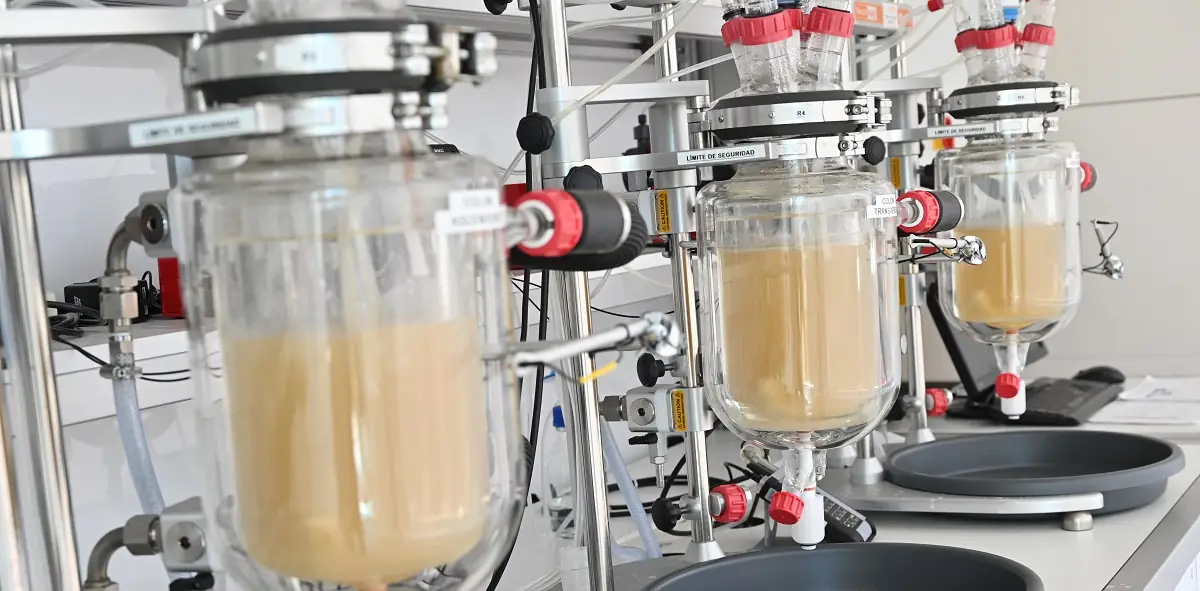
- Design and construction of the experimental setup required to carry out the evaluation tests.
- Carrying out the experimental tests required to establish a reliable correlation between the type of residue and surface, and the sanitisation procedure required to achieve the target cleaning and disinfection conditions.
- Development of an advanced vision system for continuous monitoring of residue on surfaces.
Activities
- Preliminary studies
- Set-up of the experimental installation
- Execution of experimental tests
- Analysis of results
- Dissemination
- Transfer and promotion of results
- Management and coordination
Results obtained
- After analysing the influence of residue type on surface cleanability, it was observed that, among the two residue types studied, dairy residue is easier to clean than starchy residue. On stainless steel surfaces, achieving similar removal values for starchy residue (97%) required extending the cleaning time by 50% compared to that needed for dairy residue. However, this effect was not observed on plastic surfaces, which required a similar cleaning time to achieve acceptable hygiene levels.
- With regard to the analysis of the influence of surface type, dairy residue is removed more quickly from plastic surfaces at the beginning of cleaning, but as cleaning progresses, the residue is removed faster from steel surfaces, allowing an adequate hygiene level to be achieved earlier on these surfaces. However, in the case of starchy residue, it is removed much more quickly from plastic surfaces than from steel ones at the start of cleaning, and this trend continues almost until completion.
- Regarding surface finish, a correlation was observed between surface roughness and ease of cleaning. This correlation is more pronounced in the case of starchy residue. On average, surfaces with surface roughness values above 0.8 microns showed levels of removed dirt 18 percentage points lower than surfaces with roughness values below 0.8 microns. Continuing with the analysis of the influence of surface finish, in the case of stainless steels, blasted finishes generally showed cleanability values below average. In contrast, electropolishing proved to be one of the finishes with the best cleanability values.
- In the case of plastic materials, smooth belts are clearly easier to clean than modular ones.
Summary of results:
- Type of residue: Dairy residue is easier to clean than starchy residue. On stainless steel, removing starchy residue effectively (97%) requires 50% more time than dairy residue. On plastic surfaces, both residues require similar times to achieve acceptable hygiene levels.
- Type of surface:
-
- Dairy residue: Initially removed faster on plastic, but as cleaning progresses, steel reaches the required hygiene level sooner.
-
- Starchy residue: Removed faster on plastic throughout the entire cleaning process.
- Surface finish: There is a correlation between roughness and cleaning difficulty, more pronounced with starchy residue. Surfaces with roughness >>0.8 µm show 18% less dirt removal than smoother surfaces.
-
- On stainless steel: electropolishing offers better cleanability; blasted finishes are below average.
-
- On plastics: smooth belts are easier to clean than modular ones.
If you would like to receive information on the project results, click here.
Dissemination/Transfer
The dissemination actions of the project included:
- Press releases
Approved the 9 FEDER projects submitted to the IVACE call
AINIA studies new methodologies enabling the development of more sustainable tailor-made sanitisation processes
- Generation of value-added content
Development of new tools to adapt sanitisation processes for open surfaces in food industries
Advances in tailor-made sanitisation in the food industry
- Internal communication regarding project approval
Approved the 9 FEDER projects submitted to the IVACE call
- Webinars
TECHNOLOGICAL INNOVATION & COVID-19. Solutions to guarantee safety against viral agents (3 June 2020)
Strategies to improve sustainability in industrial cleaning (22 June 2021)
Strategies to improve sustainability in industrial cleaning (video)
- Participation in events
Difusión en el CURSO AVANZADO DE DISEÑO HIGIÉNICO DE EQUIPOS E INSTALACIONES EHEDG
- Vídeos
TECHNOLOGICAL INNOVATION & COVID-19. Solutions to guarantee safety against viral agents
- Initial project poster
- Initial project poster