Developing a functional beverage involves more than incorporating ingredients with nutritional or bioactive properties. Proteins, fibres and plant extracts can present challenges related to solubility, sedimentation or incompatibility with other components. The challenge for the industry is to achieve homogeneous, safe and stable formulations that retain their characteristics throughout their shelf life and can be manufactured on an industrial scale.
Incorporating proteins without compromising stability
Protein-enriched beverages offer opportunities in sports nutrition, healthy ageing and plant-based alternatives. However, incorporating proteins into a liquid matrix is not always straightforward.
The pH, which indicates the degree of acidity of the medium, plays an important role in protein stability. When it approaches a protein’s isoelectric point, the protein loses stability and tends to aggregate, potentially forming particles or precipitates. This phenomenon is particularly relevant in certain acidic beverages.
Heat treatments can also modify protein structure and, depending on processing conditions, increase turbidity or promote precipitation.
To reduce these problems, it is advisable to select the appropriate protein based on its physicochemical and technological profile, adjust its concentration and the formulation’s pH, and study how it responds to processing.
Fibres and plant extracts: preventing sedimentation
The incorporation of fibres and plant extracts can modify the viscosity, appearance and physical stability of beverages. Some components dissolve, while others remain as suspended particles and may settle at the bottom of the packaging.
This behaviour depends on the size and density of the particles, the viscosity of the liquid and the interactions between ingredients. For example, certain soluble fibres increase viscosity, while insoluble fractions may promote sedimentation.
Therefore, a beverage that is homogeneous at the end of production may exhibit phase separation during storage.
Technologies to improve the physical stability of beverages
The choice of technologies depends on the characteristics of each formulation. For example, a beverage containing suspended solid particles presents different challenges from an emulsion, in which small oil droplets must remain distributed throughout an aqueous phase.
Reducing particle size, applying homogenisation processes or using compatible stabilisers are some of the strategies that make it possible to adjust viscosity and limit phase separation during storage.
These strategies are complemented by enzymatic treatments, which make it possible to modify certain components of raw materials and thereby adjust properties such as viscosity or solubility.
Fermentation, preservation and shelf life
During storage, functional beverages may undergo chemical and microbiological changes, such as oxidation, colour changes or microbial growth.
The choice of preservation treatment depends, among other factors, on pH, composition and distribution conditions. Heat treatment can contribute to microbiological safety, but it can also modify proteins or other sensitive ingredients. Therefore, safety and potential changes in viscosity, turbidity or precipitation must be evaluated together.
Fermentation can be used as a preservation strategy in plant-based beverages. By using selected microorganisms, this process makes it possible to transform certain components of the matrix, modify pH and acidity, and modulate the product’s aroma profile. When the aim is to keep the microorganisms responsible for fermentation viable, subsequent heat treatments that could compromise their viability should be avoided.
Packaging also influences exposure to light and oxygen. Shelf-life studies make it possible to monitor the microbiological, physicochemical and sensory changes in the product and verify whether it retains its characteristics throughout the intended period.
From prototype to industrial production
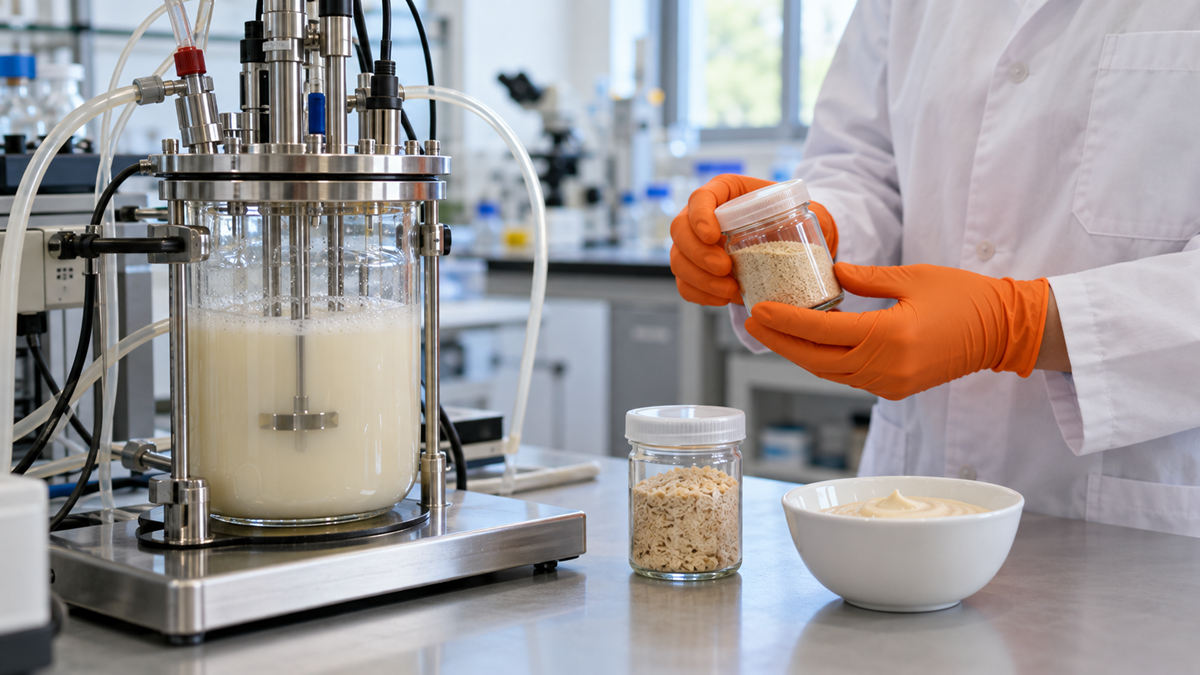
A formulation that is stable in the laboratory does not always behave in the same way when scaled up to industrial production. Mixing and homogenisation conditions, processing times and heat transfer can affect the outcome and reproducibility between batches.
Pilot trials make it possible to detect deviations, adjust parameters and assess yields and costs before production. It is also important to verify sensory quality, nutritional composition per serving and compliance with the regulations applicable to any nutrition or health claim.
How AINIA can help you
At AINIA, we help companies develop and reformulate functional beverages through ingredient selection, formulation design and optimisation, and the application of processing and preservation technologies.
We combine these capabilities with stability, safety, shelf-life and sensory evaluation studies, enabling us to address technological challenges and guide development towards subsequent industrial scale-up.
Discover our solutions for the development of new foods and ingredients and how we can help you create safe, stable functional beverages tailored to market needs.